
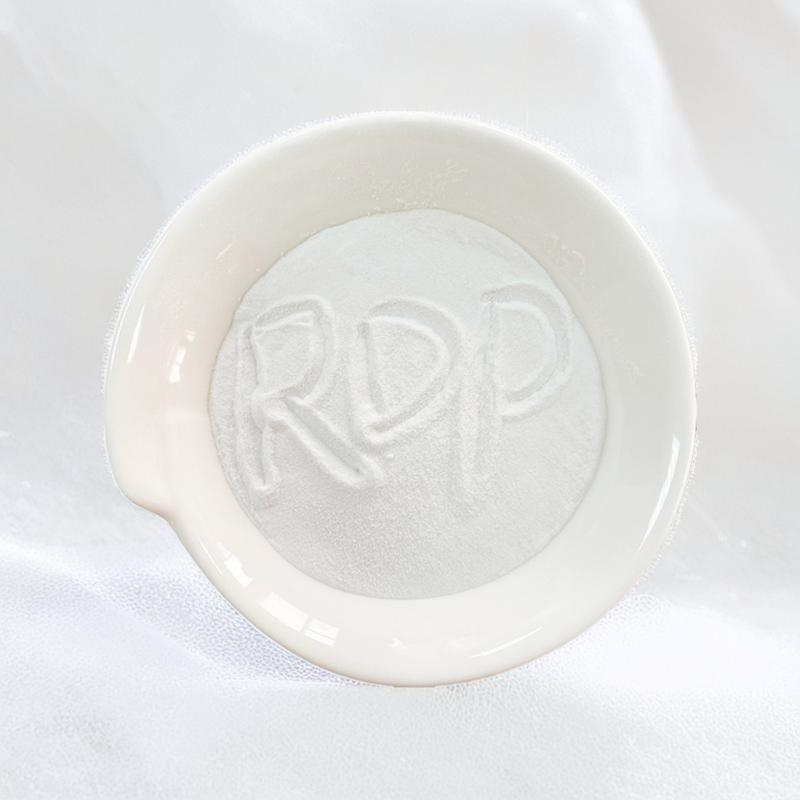
Redispersible Polymer Powder (RDP) is a white, free-flowing thermoplastic resin powder produced by spray drying polymer emulsions. When mixed with water, it rapidly redisperses to form a stable polymer emulsion, restoring its original binding and film-forming properties.
The main component of RDP is Vinyl Acetate-Ethylene (VAE) copolymer, with polyvinyl alcohol as a protective colloid, along with appropriate amounts of anti-caking agents and functional additives. The product complies with national standard GB/T 29594-2013 and industry standard JC/T 2189-2024.
Based on polymer composition, RDP is primarily classified into the following types:
| Type | Polymer Composition | Code | Main Features |
|---|---|---|---|
| Vinyl Acetate-Ethylene Copolymer | VAc/E | VAE | Most widely used, excellent overall performance |
| Vinyl Acetate-Vinyl Ester of Versatic Acid Copolymer | VAc/VeoVa | - | Better water and alkali resistance |
| Acrylate-Styrene Copolymer | A/S | - | High bond strength, good weather resistance |
| Styrene-Butadiene Copolymer | SBR | - | Outstanding flexibility |
| Vinyl Acetate Homopolymer | PVAc | PVAc | Basic product type |
Other modified products include Ethylene-Vinyl Chloride-Vinyl Laurate terpolymers and Vinyl Acetate-Ethylene-Vinyl Ester of Versatic Acid copolymers.
Based on Glass Transition Temperature (Tg), RDP can be classified as:
Rigid Type (High Tg): Tg approx. 12°C, suitable for systems requiring high hardness
Medium Flexible Type: Tg approx. 3°C, balancing rigidity and flexibility
High Flexible Type: Tg approx. -8°C, suitable for high flexibility requirements
High Flexible + Waterproof Type: Tg approx. -11°C, combining flexibility and hydrophobic properties
Typical technical specifications for RDP are as follows:
| Parameter | Typical Range | Description |
|---|---|---|
| Appearance | White powder, free-flowing | Uniform color, no lumps |
| Solid Content | ≥98.0% | Low moisture content, stable storage |
| Ash Content | 10%±2% or 12%±2% | Depends on product type |
| Bulk Density | 300-650 g/L | Varies slightly by product |
| Protective Colloid | Polyvinyl Alcohol (PVA) | Core protective component |
| pH Value | 6-9 | Slightly acidic to slightly alkaline |
| 40 Mesh Sieve Residue | ≤2.0% | Reflects product fineness |
| Parameter | Typical Range | Influencing Factors |
|---|---|---|
| Glass Transition Temperature (Tg) | -15°C to +15°C | Determined by polymer composition, reflects material rigidity |
| Minimum Film Forming Temperature (MFT) | 0-5°C | Related to Tg, affects low-temperature film-forming ability |
Products with different glass transition temperatures suit different applications: low Tg products offer better flexibility for high-flexibility systems; high Tg products offer higher hardness for rigid systems.
When RDP is added to mortar and mixed with water, the powder particles rapidly disperse in water, providing the following benefits:
Improved Workability: Enhances smoothness and spreadability
Better Flow Properties: Makes mortar easier to spread and level
Increased Thixotropy and Sag Resistance: Prevents sagging during vertical application
Enhanced Cohesion: Strengthens internal particle bonding
Extended Open Time: Provides longer working window for application
Improved Water Retention: Reduces rapid water evaporation, ensuring adequate cement hydration
As water evaporates and cement hydrates, the powder particles coalesce to form a continuous polymer film within the mortar, providing the following enhancements:
Increased Tensile Strength: Enhances the mortar's tensile capacity
Higher Flexural Strength: Improves resistance under bending loads
Reduced Elastic Modulus: Makes the mortar more flexible
Increased Deformability: Accommodates thermal expansion and contraction of the substrate
Enhanced Abrasion Resistance: Improves surface durability
Higher Cohesive Strength: Strengthens internal material bonding
Reduced Carbonation Depth: Delays carbon dioxide ingress, protecting reinforcement
Reduced Water Absorption: Some powder types can impart water-repellent properties
The modification effect of RDP on cement mortar operates at both micro and macro levels:
Polymer particles form a continuous film structure within cement pores, enhancing interfacial bonding
Formation of interpenetrating network structures with cement hydration products, improving overall mortar performance
Reduction of compressive-to-flexural strength ratio, enhancing flexibility
In external wall insulation systems, RDP is primarily used in:
Adhesive Mortar: Forms reliable bonding with insulation materials such as EPS boards and mineral wool
Base Coat Mortar: Forms a crack-resistant protective layer, improving impact resistance
RDP significantly improves the bond strength and flexibility of tile adhesives, suitable for thin-bed adhesives and grouts.
In self-leveling mortar, RDP improves flowability, increases abrasion resistance, and enhances bond strength to the substrate.
Suitable for concrete crack repair and tunnel lining restoration, improving bond strength, flexural strength, and workability.
Interior and exterior flexible putties
Dry-mix coatings
Powder paints
Adhesives for thermal insulation materials
| Application Area | Primary Functional Requirements |
|---|---|
| External Wall Insulation Systems | Bond strength, flexibility, weather resistance |
| Tile Adhesives | Bond strength, slip resistance, open time |
| Self-Leveling Mortar | Flowability, abrasion resistance, bond strength |
| Repair Mortar | Bond strength, flexibility, workability |
| Flexible Putty | Bond strength, crack resistance |
Based on mortar type and performance requirements, recommended RDP dosages are as follows:
| Application Scenario | Recommended Dosage (by weight of binder) | Description |
|---|---|---|
| External Wall Insulation Adhesive Mortar | 1.0% - 1.5% | Ensures insulation board bond failure rate |
| External Wall Insulation Base Coat Mortar | 1.5% - 2.5% | Balances flexibility and crack resistance |
| Tile Adhesive | 1.5% - 3.0% | Improves bond strength and open time |
| Self-Leveling Mortar | 1.0% - 3.0% | Improves flowability and abrasion resistance |
| Flexible Putty | 2.0% - 4.0% | Enhances flexibility and bond strength |
| Repair Mortar | 1.0% - 6.0% | Depends on strength requirements |
Note: The above are reference ranges. Specific dosage should be determined through testing based on raw material characteristics, equipment conditions, and performance targets.
Store in a cool, dry place, avoiding high temperature and humidity
After opening, use as much as possible in one go; otherwise, reseal the bag to prevent moisture absorption
Avoid stacking pallets too high to prevent prolonged excessive pressure on bags, which may cause caking
Mix thoroughly with other dry powders before adding water
After adding water and mixing, allow the mortar to rest for 5 minutes to let the powder fully dissolve and disperse, then mix again before use
Avoid excessive pressure and shear forces during mixing or conveying processes to prevent agglomeration of thermoplastic resin particles
Adjust water content based on ambient temperature and humidity
 Technical Guide for Redispersible Polymer Powder in Dry-Mix Mortar
 Redispersible Polymer Powder Market Sees Steady Growth – Green Building Drives Industry Technology U
 【Booth 12M46】Shenyang Xingzhenghe Chemical Makes Its Debut at the 26th CAC Exhibition, Launching a N
 The green building wave is driving an upgrade, presenting high-growth opportunities for the redisper