
When selecting redispersible polymer powder for dry-mix mortar, buyers often compare solids content, ash content and bulk density. These properties provide useful information, but they do not explain every difference between polymer powder grades. Temperature-related parameters, particularly glass transition temperature and minimum film-forming temperature, also deserve attention.
Glass transition temperature, commonly abbreviated as Tg, describes a change in the physical behavior of a polymer. Minimum film-forming temperature, or MFFT, describes film formation from a dispersion under specified test conditions. Although the two parameters are related, they are not interchangeable.
For tile adhesives, thermal insulation mortars, wall putties and other polymer-modified materials, understanding this distinction helps formulators select candidates for testing. The final decision should still be based on the performance of the complete mortar formulation.
The glass transition is a temperature region in which the mobility of polymer chain segments changes. As temperature increases through this region, the polymer moves from a relatively rigid state toward a more flexible response.
This transition is different from melting. Tg should therefore not be interpreted as the melting point of redispersible polymer powder.
For otherwise comparable polymers at the same service temperature, a lower Tg generally indicates a softer polymer response. A higher Tg may indicate a harder response. However, commercial RDP grades can differ in polymer chemistry, structure, protective colloids and other components.
These differences mean that Tg alone cannot establish which grade will perform better in mortar. A lower value does not automatically indicate higher adhesion, while a higher value does not automatically indicate higher mortar strength.
The practical purpose of Tg is to help explain the polymer’s temperature-dependent behavior and support the selection of grades for application testing.
When redispersible polymer powder is mixed with water, polymer particles become dispersed again. As water is removed from the system, the particles approach one another. Under suitable conditions, they deform and coalesce into a continuous film structure.
MFFT describes the lower temperature limit at which a continuous film forms under the specified test conditions.
It is important to distinguish redispersion from dissolution. The polymer component of RDP generally redistributes as particles in water rather than dissolving in the same way as a soluble salt.
A mixture may appear dry without having developed the expected polymer film structure. Film formation depends on the properties of the polymer and the conditions during water removal, rather than on visible drying alone.
When reviewing technical data, check whether the reported MFFT relates to the original liquid dispersion or to a redispersion prepared from the powder. The test system and sample preparation should be understood before comparing values.

Tg concerns the physical transition of the polymer. MFFT concerns the ability of dispersed polymer particles to form a continuous film.
| Parameter | Tg | MFFT |
|---|---|---|
| Full name | Glass transition temperature | Minimum film-forming temperature |
| Main focus | Change in polymer mobility and mechanical response | Formation of a continuous film from a dispersion |
| Practical use | Understanding temperature-dependent polymer behavior | Evaluating film formation under defined conditions |
| Does it directly define mortar application temperature? | No | No |
| Can it replace finished-mortar testing? | No | No |
A Tg value should not be copied into the MFFT field of a product specification. Similarly, an unavailable MFFT value should not be estimated from Tg without supporting information.
Two grades with similar Tg values may still behave differently during redispersion, film formation and mortar curing. Their performance should be assessed in the formulation for which they are being considered.
The appropriate polymer response depends on the application.
A mortar intended to accommodate small substrate movements may require a different balance of properties from a wall putty intended to provide a firm, sandable surface. Selecting the softer polymer in every case can overlook these differences.
For applications involving deformation, the evaluation should include the relevant deformation behavior and adhesion performance of the hardened mortar. For products where surface properties matter, hardness, cohesion, abrasion behavior or sandability may also need attention.
These properties are influenced by more than the polymer’s Tg. Binder composition, polymer dosage, aggregate grading, mixing water and curing conditions all contribute to the result.
A useful selection process begins with the requirements of the finished material. Temperature data then help narrow the range of grades worth testing.
A low MFFT does not, by itself, establish an acceptable application temperature for cement-based mortar.
Polymer film formation is only one part of mortar property development. Cement hydration, moisture availability, substrate condition and early curing must also be considered.
A polymer with a Tg below 0°C does not make the complete mortar suitable for application below freezing. Likewise, low MFFT does not demonstrate antifreeze performance.
Freezing water, an icy substrate or slow binder reactions can prevent the mortar from developing its intended properties, even when the polymer has favorable film-forming characteristics.
Temperature assessment should include more than a single air-temperature reading. Relevant conditions include:
Air temperature during application and early curing;
Substrate temperature;
Dry-material temperature;
Mixing-water temperature;
Expected temperature changes after application.
A floor or wall can be colder than the surrounding air. Acceptable daytime conditions may also be followed by a substantial overnight temperature drop.
The permitted application range should come from validated finished-product instructions and the construction procedure.
RDP is used within a system containing mineral binders, aggregates, fillers, water and functional additives. Film formation takes place alongside binder reactions and changes in moisture distribution.
An absorbent substrate can remove water from a freshly applied layer. Thin application and drying wind may accelerate moisture loss. A thicker layer, high humidity or a relatively impermeable covering can produce different drying conditions.
Other additives also influence the environment in which the polymer functions. Cellulose ether affects water retention and rheology. Defoamer selection and mixing conditions influence the air system.
Consequently, the same RDP grade can produce different results when the formulation, substrate or curing conditions change.
A film formed separately on a laboratory surface may provide useful screening information, but it does not reproduce every condition inside mortar. Film observation should support, rather than replace, application-specific testing.
Tile adhesives should be evaluated using the intended tile, substrate and application conditions.
Initial adhesion is only part of the assessment. Where the intended use involves water exposure, heat or other conditioning, the relevant performance after conditioning should also be measured.
Tg and MFFT can help explain polymer characteristics, but they cannot establish the performance classification of a tile adhesive. The complete formulation must be tested.
Base coats used in external thermal insulation systems require a suitable balance of adhesion and deformation behavior within the complete system.
A softer polymer does not compensate for unsuitable aggregate grading, excessive water, incorrect layer thickness or inadequate curing. Polymer selection needs to be considered alongside the mineral formulation and application procedure.
Wall putties often require a balance between adhesion, surface cohesion, sandability and application feel.
Changing the RDP grade may affect several of these properties at once. A grade that improves one aspect of the formulation may require further adjustment to retain another.
Temperature parameters are useful for selecting test candidates, while finished-product evaluation establishes whether the balance is appropriate.
Start with a documented reference formulation. Keep the sources and quantities of cement, aggregates, fillers, cellulose ether and other additives consistent.
An initial comparison can use equal RDP dosage, equal mixing water and the same preparation procedure. This shows the effect of a direct grade substitution.
A second comparison may adjust water to achieve similar working consistency. If this approach is used, record the water requirement separately. Results from fixed-water and adjusted-water trials should not be treated as though the test conditions were identical.
A practical test record should include:
| Test item | Information to record |
|---|---|
| RDP identification | Grade and batch number |
| Temperature data | Available Tg and MFFT information |
| Dosage | Quantity and calculation basis |
| Mixing | Water content, sequence, duration and resting time |
| Application | Substrate and layer thickness |
| Environment | Material temperature and curing conditions |
| Fresh properties | Consistency, workability and relevant air-related observations |
| Hardened properties | Adhesion, strength and other application requirements |
For adhesion testing, record the failure location as well as the measured value. Failure within the substrate, within the mortar or at an interface can lead to different interpretations.
Replicate specimens help distinguish repeatable differences between grades from individual test variation.
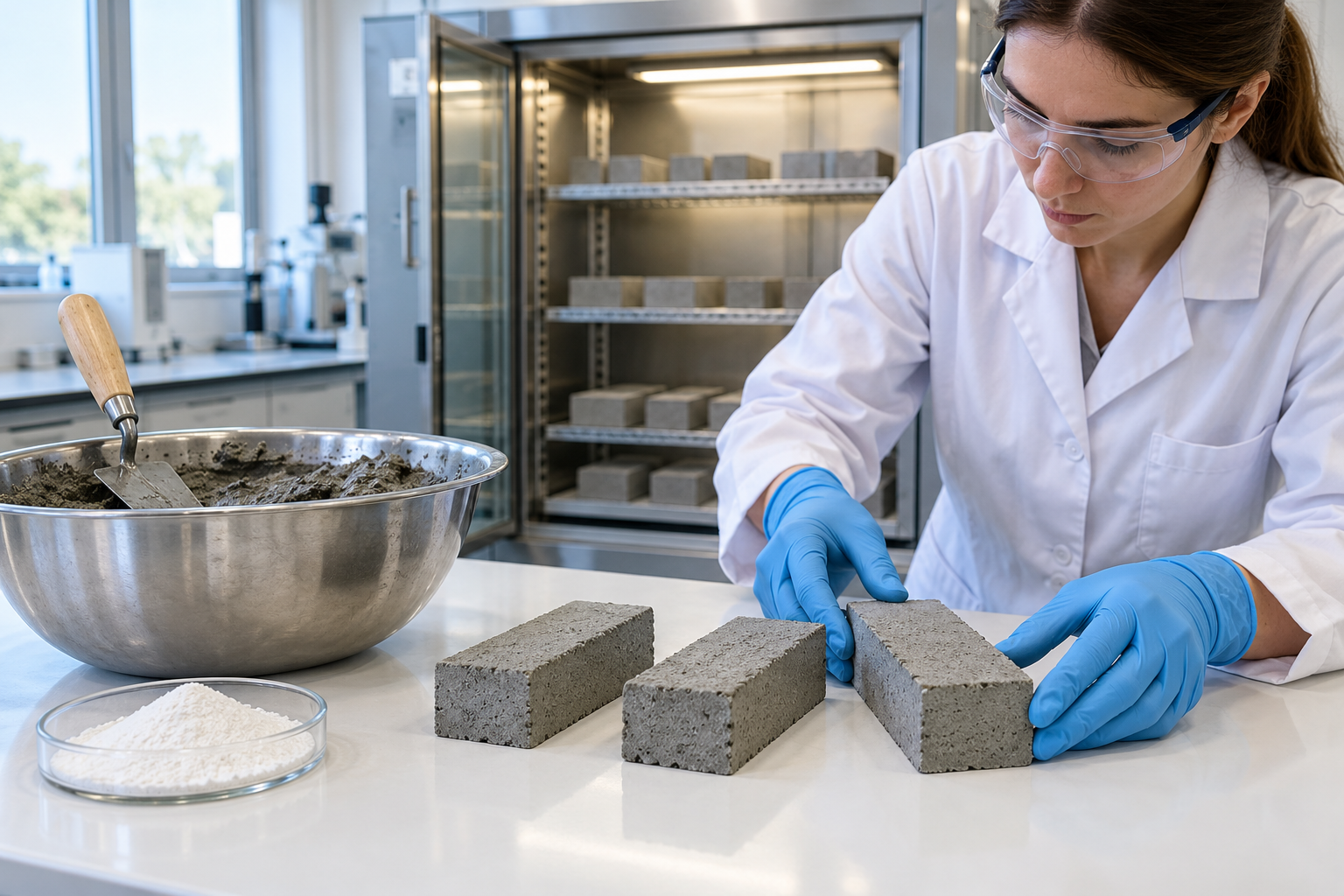
A sample request becomes more useful when it describes the actual application.
Instead of requesting only a “flexible RDP” or a “high-adhesion grade,” provide the mortar type, binder system, proposed dosage, target properties and expected application conditions.
When replacing an existing product, include reference trial results and explain which properties should be retained or improved. This gives the supplier a clearer basis for suggesting candidate grades.
It is also useful to distinguish between:
Product specification limits;
Typical reference values;
Results measured for a particular batch.
Tg and MFFT may not be included in every batch certificate. Their documentation status should be clarified before they are added to incoming inspection requirements.
Tg and MFFT provide different information about redispersible polymer powder. Tg helps explain the temperature-dependent response of the polymer, while MFFT describes film formation under defined conditions.
Neither parameter should be used independently to predict adhesion, certify a mortar grade or establish cold-weather application limits.
A practical evaluation connects application requirements, technical data, controlled formulation trials and realistic curing conditions. This approach gives mortar producers a clearer basis for selecting RDP and reviewing its performance when raw materials or project conditions change.
 RDP Tg vs MFFT: Understanding Temperature Parameters for Mortar Selection
 RDP in Self-Leveling Compounds: Balancing Flow, Adhesion and Surface Performance
 RDP in Self-Leveling Compounds: Balancing Flow, Adhesion and Surface Performance
 Why Does RDP Change After Long-Term Storage? Moisture, Caking, Redispersion and Packaging Explained