
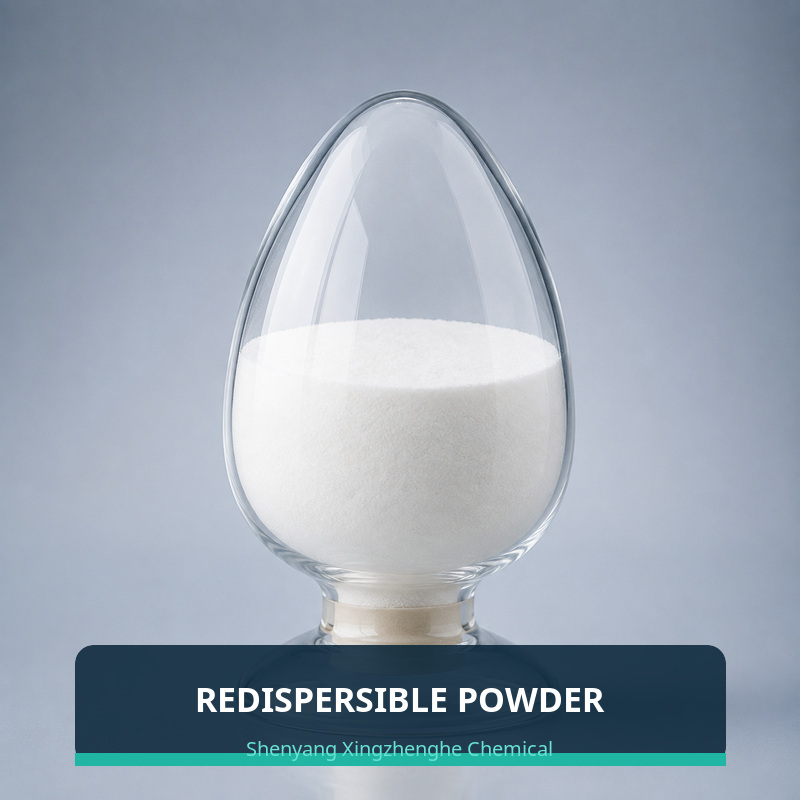
Redispersible polymer powder is normally supplied as a dry, free-flowing powder.
When stored correctly, it can be handled in a similar way to other dry-mix mortar additives.
However, manufacturers sometimes encounter a different situation after several months of storage.
A bag that originally contained loose powder may later show:
Soft lumps
Hard caking
Reduced flowability
Powder adhering to the inner bag
Difficulty in automatic feeding
Different redispersion behavior
Changes in mortar mixing
When this happens, a common question is:
“Has the RDP deteriorated?”
The answer cannot be determined from appearance alone.
Caking may result from moisture exposure, compression during stacking, temperature changes or packaging damage. In some cases, the powder can still be evaluated through controlled testing. In other cases, a significant change in physical condition may also be accompanied by application differences.
For dry-mix mortar manufacturers, understanding storage-related changes is useful because RDP performance does not depend only on the material leaving the factory. It can also depend on what happens during:
packaging → transportation → warehousing → opening → production use.
Redispersible polymer powder is produced so that a polymer dispersion can be converted into a dry powder and later redispersed when water is added.
This means the product needs to remain sufficiently dry during storage.
If moisture enters the package, powder particles may begin to:
Adhere to each other
Form agglomerates
Lose free-flowing characteristics
The degree of change depends on how much moisture enters, how long the material is exposed and the storage temperature.
This is why warehouse conditions can influence powder handling even when the product originally met specification.
Not all lumps have the same significance.
Soft agglomerates may form because powder has been compressed during:
Pallet stacking
Container transportation
Long-term storage
These lumps may break apart relatively easily.
Hard caking is different.
If the powder has absorbed moisture, particles may bond more strongly.
Hard lumps may be difficult to break manually and may indicate that the powder experienced more significant humidity exposure.
Therefore, the first question should not simply be:
“Are there lumps?”
but:
“How hard are they, and what caused them?”
RDP is stored as a dry powder, but warehouse air contains moisture.
If packaging is not fully sealed, water vapor may gradually enter.
High-humidity environments can increase this risk.
This is particularly relevant in:
Coastal areas
Rainy seasons
Tropical climates
Warehouses without humidity control
Long-term exposure can affect powder flow even if liquid water never directly contacts the bag.
For this reason, packaging integrity and warehouse humidity should be considered together.
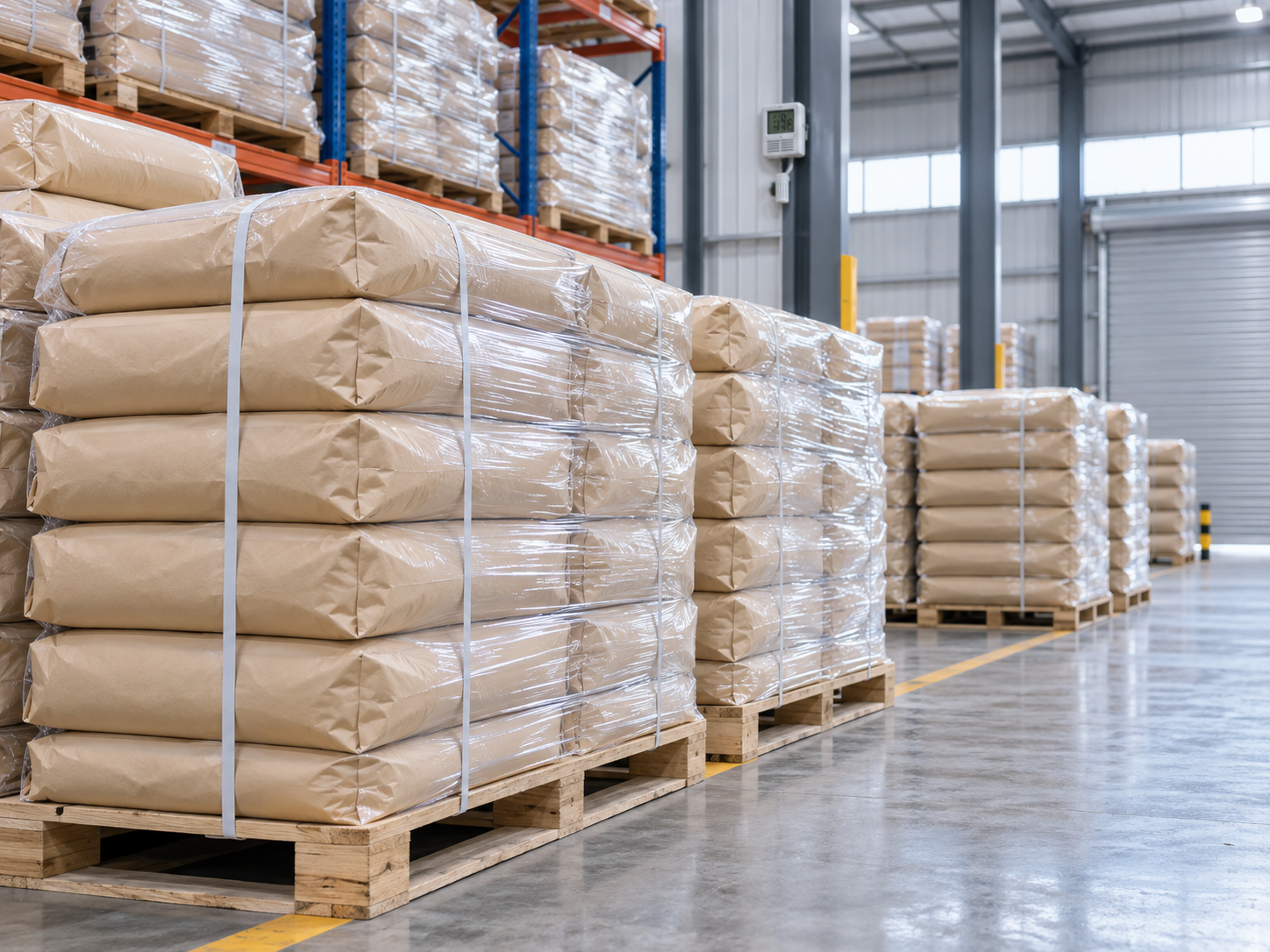
Packaging may include more than one layer.
The outer bag can appear normal while the inner moisture barrier has:
A small puncture
A weak seal
Damage from handling
Damage caused by pallet edges
These defects may not be immediately visible.
Over time, moisture can enter slowly.
Therefore, when only a few bags in one pallet show strong caking, it is useful to inspect packaging condition before assuming that the entire production batch has changed.
Temperature affects both the powder and the surrounding air.
When warehouse temperature changes significantly between day and night, condensation can occur under certain conditions.
Temperature also influences:
Humidity
Packaging pressure
Powder compaction
RDP should therefore not be stored in locations with repeated exposure to:
Strong sunlight
Roof heat
Direct heating sources
Large temperature fluctuations
Storage recommendations should follow the actual supplier documentation.
High temperature does not automatically mean that every RDP will cake.
However, elevated temperature combined with:
Humidity
Pressure from stacking
Long storage duration
may increase the likelihood of physical changes.
This is why storage problems are often caused by several factors acting together rather than by one isolated condition.
A full pallet places pressure on the bags near the bottom.
During long-term storage, this pressure can compact the powder.
Compaction may make the product feel less free-flowing even without serious moisture exposure.
This is especially noticeable if pallets are stacked in a way that places additional load on lower layers.
Warehouse operators should therefore follow appropriate stacking and pallet-handling practices.
Yes.
During long-distance transport, bags experience:
Vibration
Pressure
Repeated movement
Powder can settle and become more compact.
After arrival, a product may therefore feel denser than a freshly packed sample.
This does not automatically indicate chemical deterioration.
However, if compaction is accompanied by:
Hard wet lumps
Damaged packaging
Abnormal odor
Strong moisture uptake
further testing is advisable.
RDP is generally supplied as a white or light-colored powder.
A slight visual difference between batches may attract attention, but storage problems are often more closely related to:
Moisture
Caking
Flowability
Redispersion
than to minor color differences.
Therefore, when inspecting stored material, powder condition is usually more informative than simply comparing whiteness.
Moisture can affect powder particles in several ways.
The powder may become:
Less free-flowing
More cohesive
More difficult to dose
If moisture exposure is significant, some particles may agglomerate strongly.
In automated dry-mix plants, this can create practical problems such as:
Bridging in hoppers
Unstable feeding
Poor micro-dosing
Residue inside feeding equipment
So even before mortar performance changes, storage condition may already affect production handling.
RDP is normally used at a relatively low dosage compared with cement and sand.
This means accurate feeding is important.
If the powder does not flow consistently, the dosing system may deliver:
Too little material
Too much material
Irregular feed rates
The resulting dry mix may then show batch variation.
Therefore, powder flow is not only a packaging issue; it can influence formulation consistency.
This should not be assumed.
If the caking comes mainly from physical compression, breaking the lumps may restore handling.
If the caking resulted from moisture exposure, crushing the material does not remove the absorbed moisture or reverse other changes that may have occurred.
A more appropriate approach is to test the material after deagglomeration.
Useful checks may include:
Moisture
Powder flow
Redispersion
Mortar application performance
Only then can its suitability be judged.
The defining function of RDP is its ability to redisperse when mixed with water.
If storage changes the powder structure, redispersion behavior may also change.
Possible observations include:
Slower wetting
Persistent agglomerates
Non-uniform dispersion
Deposits after standing
This does not mean every stored sample will show such changes, but redispersion is a useful checkpoint when material condition appears abnormal.
A simple comparison can use:
Fresh reference sample and stored sample.
Keep constant:
Water quantity
Powder quantity
Water temperature
Mixing speed
Mixing time
Then observe:
Wetting
Agglomerates
Uniformity
Sediment after standing
This is a screening test only.
The final decision should still be based on actual mortar application.

Mortar is much more complex than water.
The real system contains:
Cement
Sand
HPMC
Mineral fillers
Other additives
An RDP that appears slightly different in water may still behave acceptably in mortar.
Conversely, a sample that looks normal in water may produce different application results.
Therefore, water redispersion testing and mortar testing answer different questions.
Use the same base formulation.
The only change should be:
Fresh RDP vs Stored RDP.
Keep constant:
RDP dosage
Cement
Sand
HPMC
Water
Mixing conditions
Then compare:
Fresh consistency
Wet density
Workability
Adhesion where relevant
Other application-specific properties
This provides more useful evidence than appearance alone.
If the stored powder produces a slightly different mortar consistency, it may be tempting to immediately adjust water.
But if water changes during the first comparison, it becomes difficult to know whether the difference came from:
RDP
Water
The initial test should therefore keep water unchanged.
After the baseline difference is understood, formulation adjustment can be evaluated separately.
Powder compaction during storage and transportation may change apparent bulk behavior.
This can be relevant to plants using volumetric feeding.
Even if the mass dosage remains correct, a change in packing density may affect:
Hopper flow
Screw feeding
Volumetric calibration
For automated plants, the feeding system should be checked when a long-stored batch behaves differently from a fresh batch.
Micro-additive dosing equipment often handles relatively small quantities.
Hard lumps can:
Block narrow outlets
Interrupt screw feeding
Cause irregular discharge
This may create production variability even when the chemical quality of most of the powder remains acceptable.
Therefore, storage management can directly affect process stability.
Once a bag is opened, the original moisture barrier is no longer intact.
If only part of the bag is used, the remaining powder may be exposed to warehouse air.
In high humidity, this can accelerate:
Moisture uptake
Caking
Flowability changes
Opened bags should therefore be resealed appropriately and used according to the facility's storage procedure.
Bags stored directly on a warehouse floor may be exposed to:
Ground moisture
Water cleaning
Condensation
Accidental spills
Using pallets helps separate bags from the floor.
However, pallet storage does not completely solve the problem if the warehouse itself is humid or if packaging is damaged.
Exterior warehouse walls can experience:
Temperature differences
Condensation
Water leakage
Bags placed directly against such surfaces may face higher moisture risk.
A dry, ventilated storage area with appropriate spacing can reduce unnecessary exposure.
For imported or exported RDP, receiving inspection can include:
Container condition
Evidence of water ingress
Bag integrity
Pallet condition
Visible caking
Batch labels
If only a limited number of bags were exposed to water, separating the affected material from apparently normal material can make investigation easier.
During ocean transportation, containers may experience large temperature changes.
Warm humid air can contact cooler surfaces and form condensation.
This is sometimes referred to as container sweating.
Whether it becomes a practical issue depends on:
Route
Season
Container conditions
Packaging
Moisture-resistant packaging is therefore relevant for long-distance powder transport.
No.
Stretch film can help stabilize the pallet and provide some protection, but it should not be treated as a complete moisture barrier.
The primary bag packaging still needs to remain intact.
If the bag itself is punctured, outer pallet film may not fully prevent moisture entry.
For a moisture-sensitive powder, the package is part of the delivery system.
The customer does not only receive polymer powder.
The customer receives:
powder + bag + sealing + palletization + transportation condition.
If packaging does not protect the powder until use, laboratory product specifications alone cannot guarantee satisfactory handling at the plant.
The exact label depends on supplier and customer requirements.
Common commercial information may include:
Product name
Batch number
Net weight
Production information
Storage information
Clear batch identification is particularly useful when investigating storage problems.
It allows the customer to determine whether several affected bags belong to the same production lot.
Suppose a customer finds caking in five bags.
If the batch number is available, the customer can check whether:
All affected bags belong to one batch
Other bags from the batch are normal
Packaging damage occurred only on one pallet
This helps distinguish:
Production issues
Warehouse issues
Transportation damage
Without batch traceability, investigation becomes more difficult.
A practical warehouse approach is to use older qualified stock before newer stock.
This reduces unnecessary long storage.
Inventory records can also include:
Arrival date
Batch number
Storage location
Packaging condition
These records are useful when comparing fresh and older material.
Commercial RDP products are normally supplied with a storage period or shelf-life recommendation from the manufacturer.
The actual information should be taken from the product documentation.
Shelf life assumes appropriate storage conditions.
If the product has been:
Exposed to moisture
Stored in damaged packaging
Subjected to unusual conditions
the printed storage period alone cannot determine suitability.
Not necessarily in a simple physical sense, but neither should material beyond its documented storage period automatically be treated as unchanged.
A shelf-life date represents the manufacturer's storage guidance under specified conditions.
Material outside that period may require additional evaluation before use.
For industrial production, internal quality procedures should determine whether retesting is required.
Depending on the customer's quality system, useful checks may include:
Appearance
Caking
Moisture
Flowability
Redispersion
Mortar performance
The test program should focus on the properties that matter to the actual application.
For example, a tile-adhesive manufacturer may also check adhesion and application behavior.
A bag can be mechanically deagglomerated and look normal again.
But appearance does not answer whether the polymer still behaves correctly in mortar.
The useful question is:
“Does the stored material still produce the required finished-mortar performance?”
That should be confirmed through application testing.
If storage changes powder redispersion or dosing accuracy, tile adhesive behavior may potentially change.
Useful comparison points include:
Water demand
Troweling
Open time
Adhesion
Again, the presence of lumps alone does not prove that all these properties have changed.
Controlled testing is required.
External insulation mortar relies on the polymer component for several aspects of performance.
If an RDP batch has experienced abnormal storage, a manufacturer may compare:
Workability
Adhesion
Flexibility-related behavior
Mortar consistency
This is particularly useful before using a large quantity of questionable stock.
A small amount of moisture exposure over one day may have limited visible effect.
The same environment over several months can produce more noticeable changes.
This means warehouse problems may appear gradually.
A product may be easy to handle when first delivered but more difficult after a long rainy season.
Long-term humidity control therefore matters more for slow-moving inventory.
Possibly.
If the product was stored normally during a dry season and later experienced a humid season, the warehouse environment may have changed even though:
Supplier
Product
Batch specification
did not.
This is why caking investigations should include storage history rather than focusing only on the raw material supplier.
Basic warehouse records can help identify patterns.
For example, repeated caking may occur only:
During certain months
Near a particular wall
On lower pallets
After long storage
This type of pattern can point toward storage or handling causes.
Without records, every case may appear to be an isolated product problem.
This may indicate a mechanical or environmental factor such as:
Higher stacking pressure
Floor moisture
Local packaging damage
It does not automatically indicate that all material in the batch is defective.
The affected and unaffected bags should be compared separately.
If many bags show similar severe caking, the investigation should be broader.
Possible areas to check include:
Batch packaging
Storage environment
Transportation history
Moisture exposure
Samples can then be tested to determine whether the physical change is accompanied by an application change.
A first visual inspection can identify:
Soft lumps
Hard lumps
Torn bags
Moisture marks
Poor flow
However, warehouse inspection cannot confirm polymer performance.
Laboratory testing remains necessary when material condition is questionable.
When reporting a caking problem, useful information includes:
Batch number
Delivery date
Storage duration
Warehouse condition
Photos of packaging
Number of affected bags
Whether bags were opened
This helps distinguish possible packaging, transportation and storage causes.
Simply reporting:
“The powder has lumps”
provides too little information for technical investigation.
Customers can clarify:
Destination
Shipping method
Expected transit time
Packaging requirements
Pallet requirement
Warehouse climate
This is particularly relevant for destinations with high humidity or long sea transport.
Packaging arrangements can then be confirmed before shipment.
A lower-cost package may reduce immediate purchase price.
But if inadequate packaging increases:
Moisture risk
Bag breakage
Powder loss
Handling problems
the overall cost may increase.
For long-distance shipment, packaging should therefore be evaluated as part of the total supply arrangement.
A practical sequence is:
inspect packaging → separate affected stock → identify batch → check moisture and physical condition → compare redispersion → run mortar test → decide according to internal quality requirements.
This prevents uncertain material from being mixed directly into normal production.
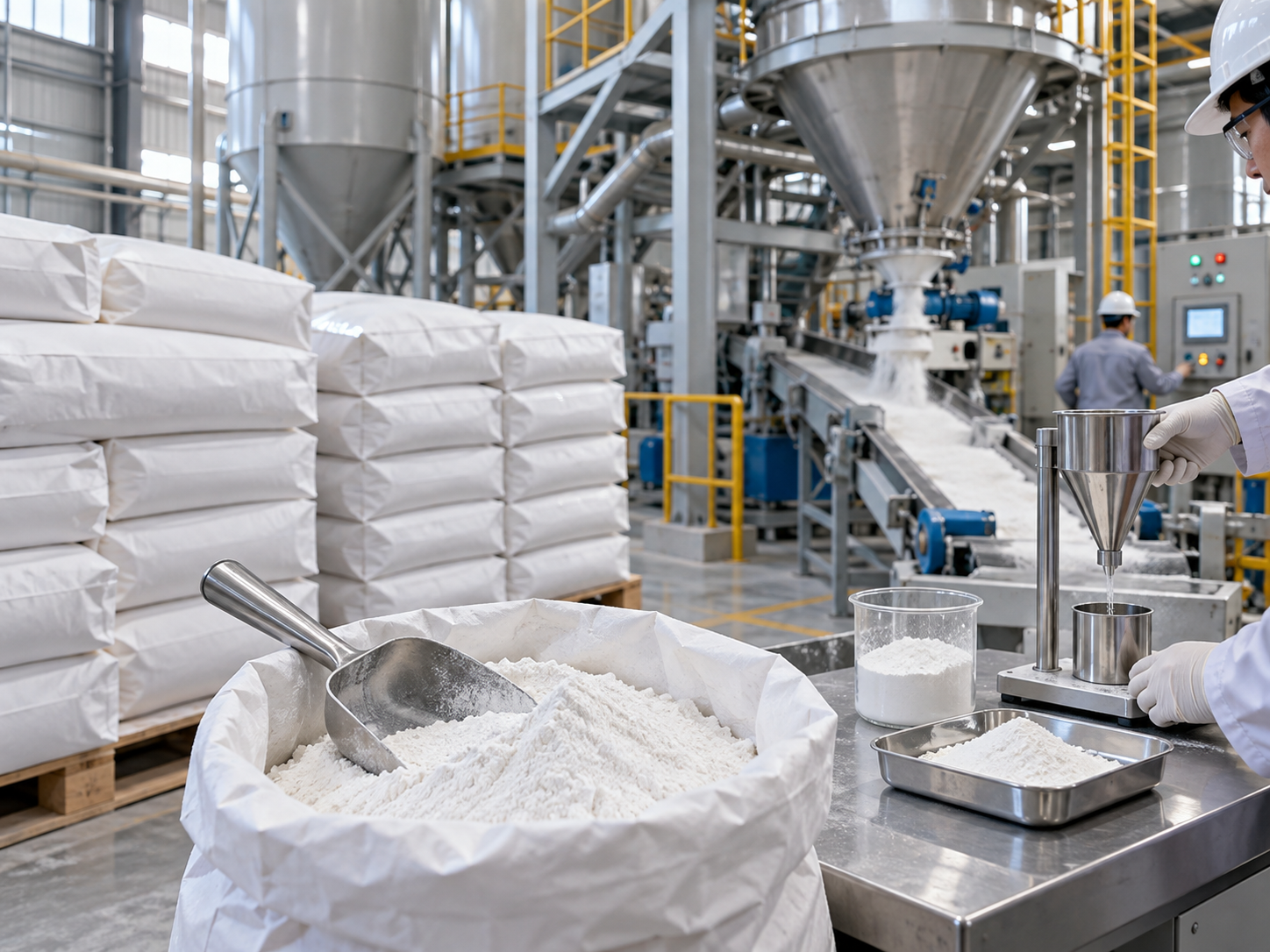
Possible causes include humidity, moisture ingress, compression, packaging damage, long storage duration and temperature changes.
Not necessarily. Soft physical compaction and moisture-related caking are different. Application testing is needed to judge actual performance.
They can be broken mechanically, but this does not prove that storage has not affected the material. Further testing is advisable.
Moisture can reduce flowability, promote agglomeration and create feeding problems in dry-mix production.
It may if the powder has experienced abnormal moisture or storage conditions. A controlled redispersion comparison can be used as a screening test.
Yes. Once opened, the powder is more exposed to ambient humidity and should be protected according to the facility's storage procedure.
No. Shelf-life guidance assumes appropriate storage. Damaged packaging or unusual moisture exposure may require retesting.
If storage duration is long or powder condition appears abnormal, retesting can help confirm suitability before larger-scale use.
When redispersible polymer powder changes after long-term storage, the cause should not be judged from caking alone.
A more useful evaluation considers the entire storage history:
humidity + temperature + packaging + pallet pressure + transportation + warehouse duration.
For dry-mix mortar manufacturers, the practical question is whether the stored material can still be:
Dosed consistently
Redisperse adequately
Produce the required mortar performance
Therefore, when abnormal stock is discovered, a systematic approach is more useful than simply breaking up the lumps or immediately discarding the material.
The recommended logic is:
inspect → identify storage cause → compare with fresh reference → test redispersion → verify in mortar → decide according to production requirements.
Shenyang Xingzhenghe Chemical Co., Ltd. supplies VAE redispersible polymer powder for tile adhesive, external insulation mortar and other dry-mix mortar applications. Product specifications, packaging information, samples and batch documents can be provided according to customer requirements. Storage and final product suitability should be evaluated according to the actual product documentation and application conditions.
 Why Does RDP Change After Long-Term Storage? Moisture, Caking, Redispersion and Packaging Explained
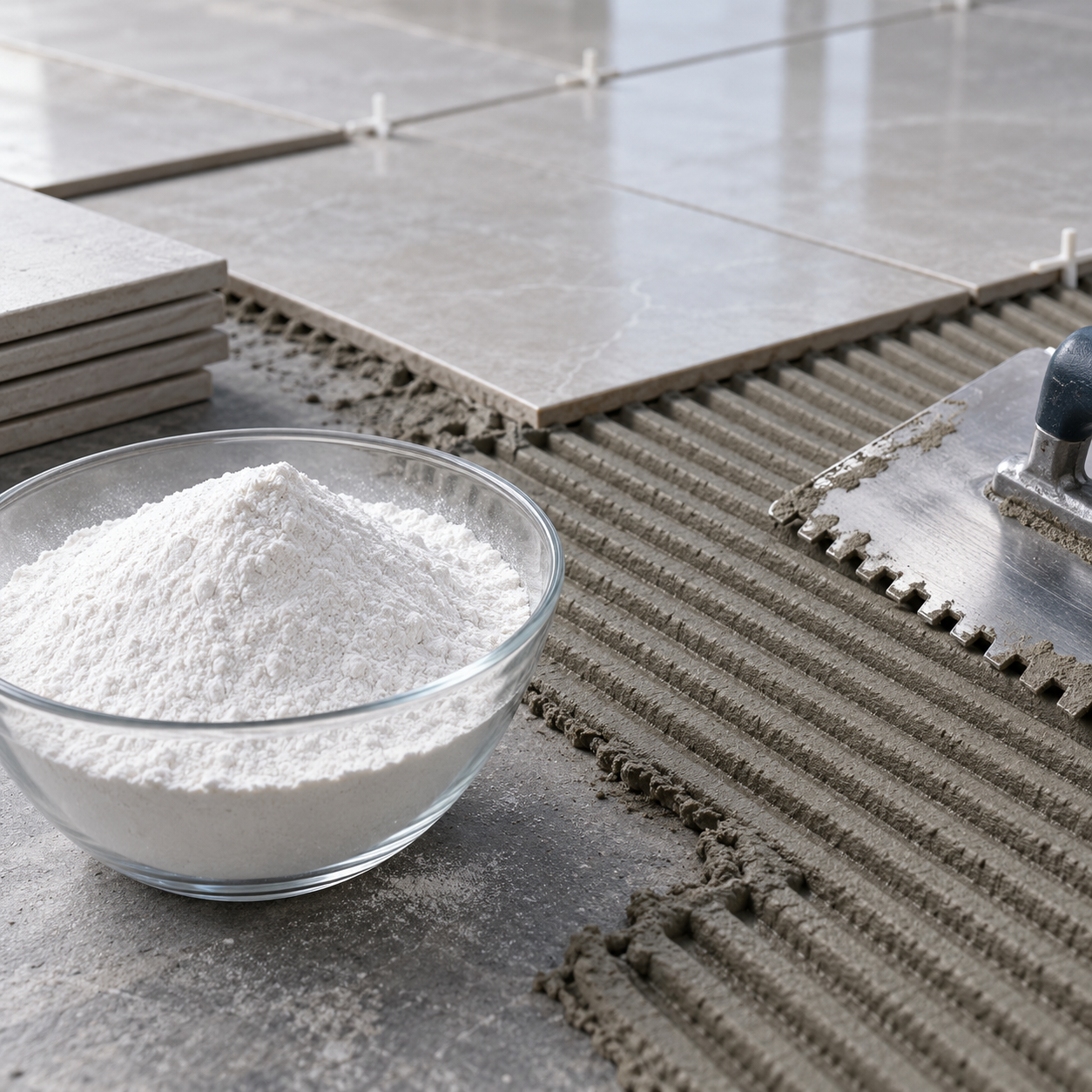 How Does Redispersible Polymer Powder (RDP) Improve the Performance of Tile Adhesive?
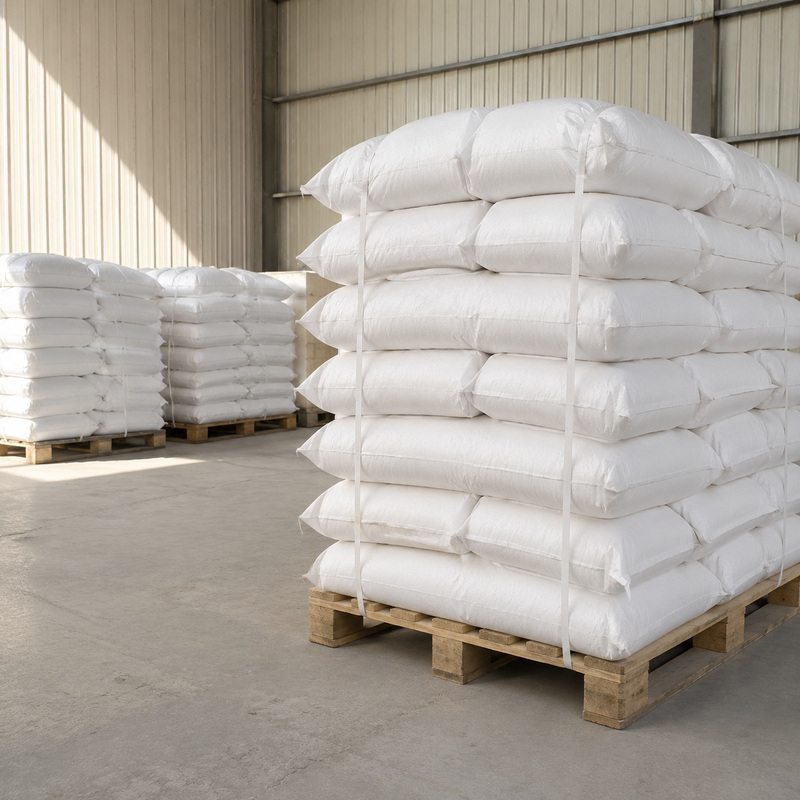 How to Compare RDP Samples Before Changing Suppliers
 What Is Redispersible Polymer Powder (RDP)? How It Works in Dry Mix Mortar