
When discussing redispersible polymer powder dosage, expressions such as “add 2% RDP” or “use 20 kilograms per tonne” can appear straightforward. However, they remain incomplete unless the calculation basis is clearly defined.
A percentage based on total finished dry-mix mass is different from a percentage based on cement mass. Adding RDP to an existing batch also produces a different result from including it within a fixed batch weight.
Clear dosage calculations help laboratory staff, production operators and purchasing teams work from the same formulation. The starting point is to identify the denominator: the material mass against which the RDP quantity is calculated.
RDP dosage can be expressed in several ways. The appropriate calculation depends on how the formulation or technical instruction defines it.
| Dosage expression | Calculation basis | Information to confirm |
|---|---|---|
| Percentage of total finished dry mix | All dry ingredients, including RDP | Whether the formulation totals 100% |
| Percentage of cement mass | Cement contained in the formulation | Whether other binders are excluded |
| Percentage of total binder mass | The explicitly defined binder system | Which materials count as binders |
| Kilograms per tonne of finished dry mix | 1,000 kg of finished dry product | Whether RDP is included in that tonne |
| Addition to an existing base mix | Base material before adding RDP | Whether the final batch mass increases |
The statement “RDP dosage is 2%” should therefore be accompanied by a basis, such as “2% of total finished dry-mix mass.”
The numerical examples below illustrate calculation methods only. They are not recommended dosages for a particular mortar or RDP grade.
When dosage is based on the total finished dry-mix mass, including RDP, the calculation is:
RDP mass = Total finished dry-mix mass × RDP mass fraction
For a 1,000 kg finished batch containing 2% RDP:
RDP mass = 1,000 × 0.02 = 20 kg
The 20 kg of RDP is included within the 1,000 kg batch. All remaining dry ingredients must therefore total 980 kg.
| RDP percentage of finished dry mix | RDP per 1,000 kg of finished dry mix |
|---|---|
| 0.5% | 5 kg |
| 1.0% | 10 kg |
| 1.5% | 15 kg |
| 2.0% | 20 kg |
| 2.5% | 25 kg |
| 3.0% | 30 kg |
The reverse calculation is:
RDP percentage = RDP mass ÷ Total finished dry-mix mass × 100%
For example, 25 kg of RDP within a 1,000 kg finished batch represents 2.5% by mass.
These conversions apply only when the total batch includes the polymer powder.
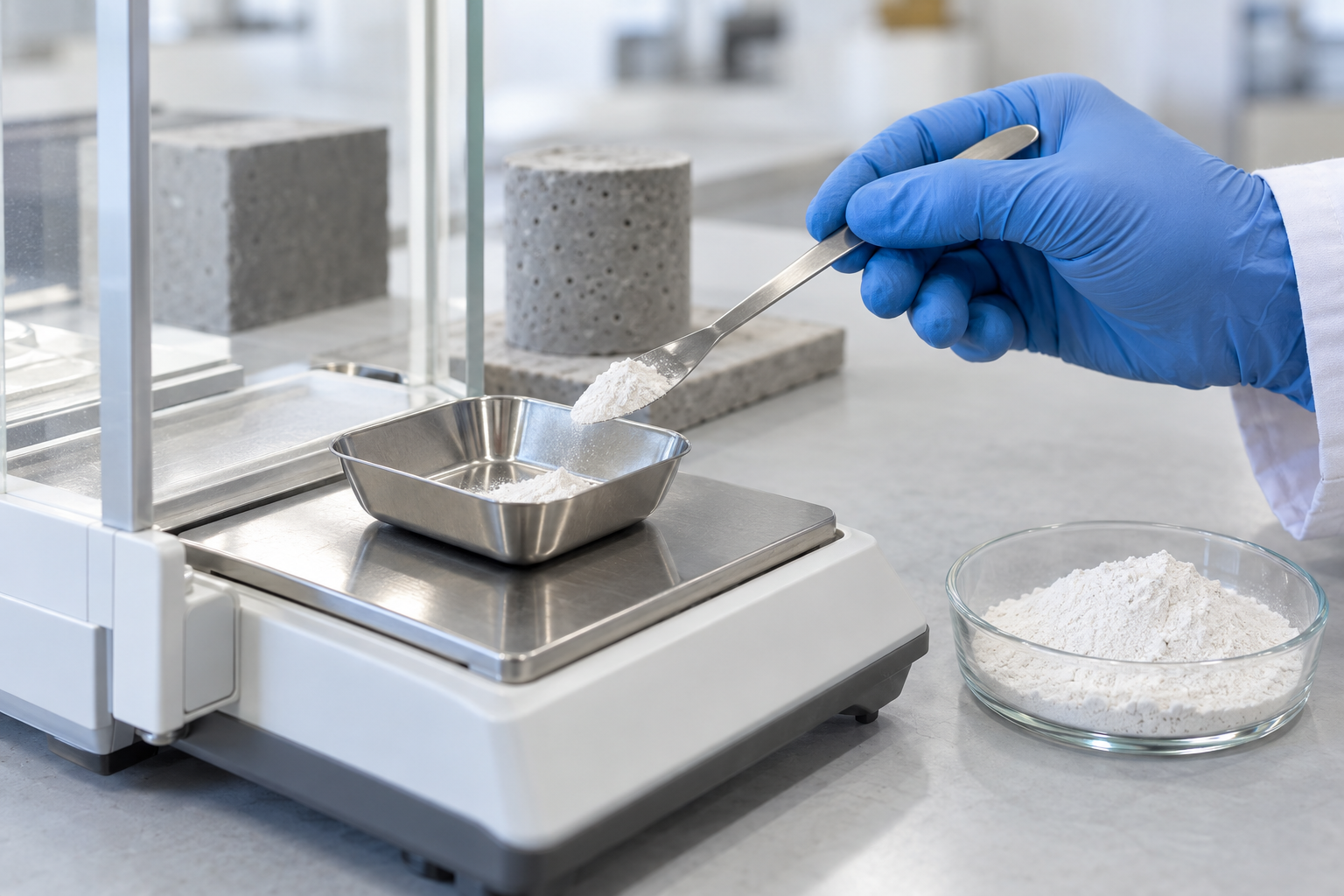
When RDP dosage is expressed as a percentage of cement mass, the cement quantity becomes the denominator.
Consider a 1,000 kg finished dry-mix formulation containing 300 kg of cement. If RDP is specified at 2% of cement mass:
RDP mass = 300 × 0.02 = 6 kg
The RDP percentage of the complete finished dry mix is then:
6 ÷ 1,000 × 100% = 0.6%
The difference is significant:
| Calculation instruction | RDP quantity |
|---|---|
| 2% of a 1,000 kg finished dry mix | 20 kg |
| 2% of the 300 kg of cement within that mix | 6 kg |
Both instructions contain “2%,” but they produce different quantities.
Where a formulation contains multiple binders, “cement basis” and “total binder basis” also need to be distinguished. A blend containing cement, gypsum or other binder components requires an explicit definition of which materials are included in the calculation.
These are different batching methods.
If a finished 1,000 kg dry mix contains 20 kg of RDP:
RDP percentage = 20 ÷ 1,000 × 100% = 2%
If 20 kg of RDP is added to an existing 1,000 kg base mix, the final batch weighs 1,020 kg:
RDP percentage = 20 ÷ 1,020 × 100% ≈ 1.96%
This distinction affects the final composition, batch mass and expected packaging quantity.
If the starting base mix weighs 1,000 kg and RDP must represent 2% of the final mass after addition, the required quantity can be calculated as:
RDP mass = Base-mix mass × Target fraction ÷ (1 − Target fraction)
Therefore:
RDP mass = 1,000 × 0.02 ÷ 0.98 ≈ 20.41 kg
A production instruction should state whether RDP is included within the finished batch weight or added on top of an existing base formulation.
RDP dosage and polymer-to-cement ratio are related, but they should not automatically be treated as identical.
Commercial redispersible polymer powder may contain a base polymer, protective colloids, antiblocking components and other ingredients. The mass of the complete RDP product is therefore not necessarily the same as the polymer mass defined by a particular calculation method.
For example, consider a finished formulation containing:
Cement: 300 kg;
RDP: 20 kg;
Other dry ingredients: 680 kg.
The RDP-product-to-cement mass ratio is:
20 ÷ 300 × 100% ≈ 6.67%
This is directly identifiable as the ratio of the supplied RDP product to cement. Calling it the polymer-to-cement ratio requires a clear definition of polymer content.
Where the definition and supporting data are confirmed:
Polymer-to-cement ratio = RDP mass × Defined polymer mass fraction ÷ Cement mass
If the result is expressed as a percentage, multiply the ratio by 100%.
Solids content should not automatically be substituted for base-polymer content. Likewise, calculating polymer content as “100% minus ash” can introduce an unsupported assumption.
When the necessary composition data are unavailable, recording the RDP grade, RDP mass and cement mass provides a clearer basis for comparison.
Laboratory trials and production batches should use the same dosage basis. Once that basis is established, ingredient quantities can be scaled proportionally.
For RDP at 2% of total finished dry-mix mass:
| Total finished dry-mix mass | RDP quantity |
|---|---|
| 1 kg | 20 g |
| 5 kg | 100 g |
| 10 kg | 200 g |
| 25 kg | 500 g |
| 1,000 kg | 20 kg |
In a 5 kg laboratory batch, the 100 g of RDP is already included within the 5 kg total. The remaining dry ingredients should total 4,900 g.
Mixing water should be recorded separately. Adding water does not change the RDP percentage calculated on a dry-mix basis.
For example, a 5 kg dry mix containing 100 g of RDP remains a 2% RDP formulation on that basis after water is added. Its RDP percentage of total wet-mortar mass would be a different calculation and should be labeled accordingly.
For production scaling, the proportional relationship is:
Production ingredient mass = Laboratory ingredient mass × Production dry-batch mass ÷ Laboratory dry-batch mass
All quantities must use compatible units before applying the formula.
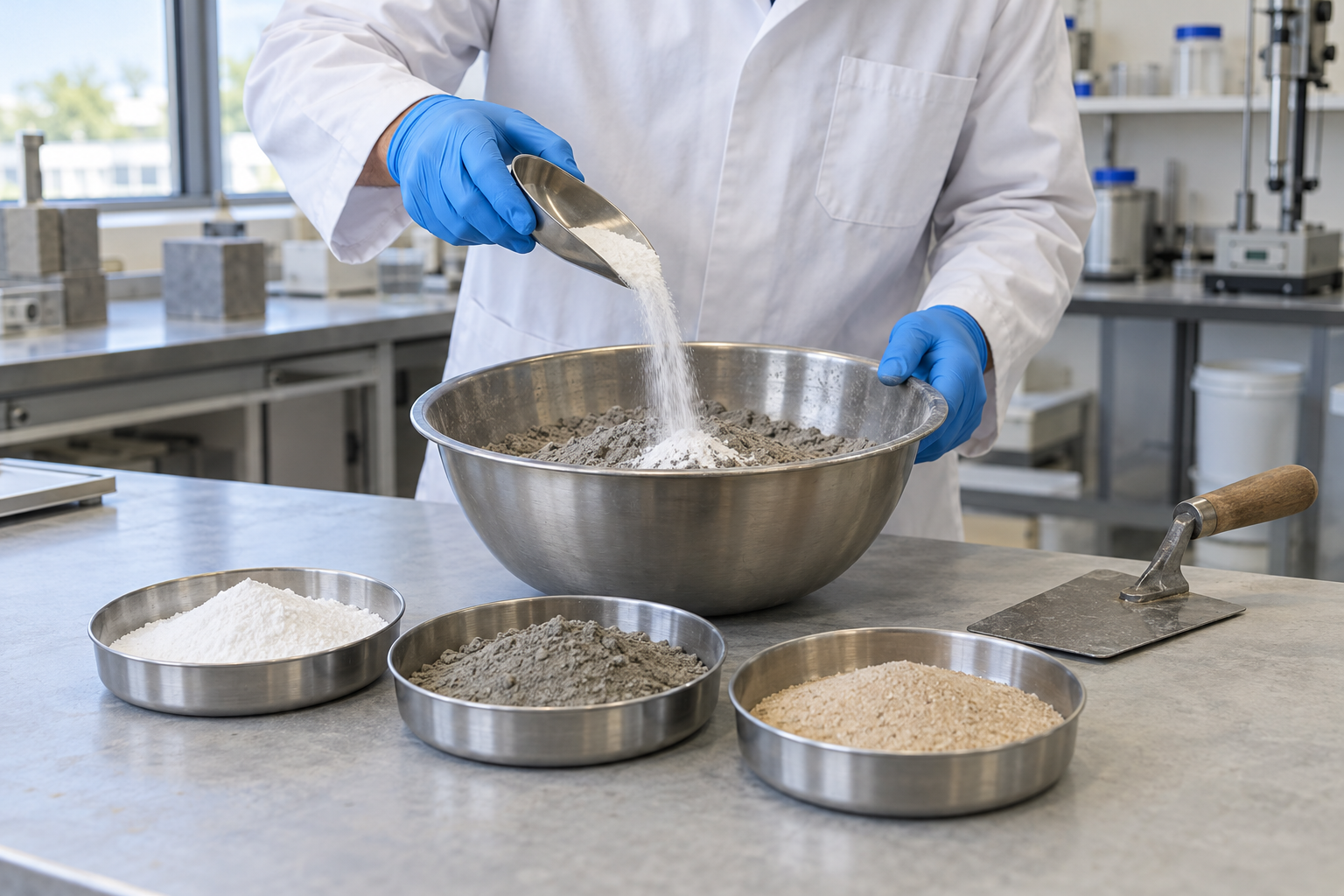
When the finished batch mass is fixed, increasing RDP requires a corresponding adjustment to other ingredients.
For example, increasing RDP from 20 kg to 25 kg in a 1,000 kg formulation adds 5 kg. If all other ingredient quantities remain unchanged, the batch becomes 1,005 kg.
A comparison trial should therefore define how the additional RDP is accommodated. Depending on the experimental purpose, it may replace an equal mass of a specified filler, or it may be added outside the original batch mass.
Neither approach should be left undocumented. Replacing filler changes the formulation, while adding RDP on top changes both total mass and the relative proportions of the other ingredients.
The trial record should identify:
The change in RDP mass;
The ingredient adjusted to maintain batch mass;
The final dry-batch total;
Whether mixing water remains fixed;
The purpose of the comparison.
This makes it possible to distinguish a fixed-total-mass trial from an addition-to-base-mix trial.
Equal dosage means that the same proportion of an RDP product has been added on the same calculation basis. It does not establish equal performance.
RDP grades can differ in polymer composition, film-forming characteristics and compatibility with the mortar system. Cement, aggregate grading, fillers, cellulose ether, defoamer and mixing water also influence the result.
A fair comparison starts by standardizing the dosage basis and documenting the other variables.
A fixed-water trial helps show the effect of direct substitution. A separate trial adjusted to similar working consistency can show differences in water demand and practical handling. These approaches answer different questions and should be analyzed separately.
Evaluation should include the fresh and hardened properties relevant to the application. Mixing feel alone is insufficient to determine whether an RDP dosage is suitable.
A useful record allows another person to check the calculations and reproduce the trial.
| Record item | Information to include |
|---|---|
| Application | Tile adhesive, insulation mortar, wall putty or another material |
| RDP identification | Grade, batch number and sample condition |
| Dosage basis | Finished dry mix, cement or explicitly defined binder mass |
| Batch total | Combined mass of all dry ingredients |
| Actual quantities | Weighed amounts of RDP and other materials |
| Formulation adjustment | Addition outside the base mix or replacement of another ingredient |
| Mixing procedure | Water quantity, mixing duration and resting time |
| Specimen preparation | Substrate, layer thickness and specimen count |
| Curing and testing | Temperature, humidity, age, test methods and results |
For dosage-series trials, record both the percentage and the actual weighed quantity. Descriptions such as “low dosage” and “high dosage” are difficult to transfer into a production instruction without the underlying numbers.
Clear units are also important. Confusing grams with kilograms or entering a percentage as a whole number instead of a decimal fraction can produce substantial errors.
A sample request is easier to interpret when it includes the percentage, mass equivalent and calculation basis.
For example:
“RDP will be evaluated at 2% of total finished dry-mix mass, equivalent to 20 kg within each 1,000 kg finished batch. The RDP quantity is included in the batch total.”
If the dosage is based on cement, provide the cement quantity as well. This allows both parties to convert the instruction into the same dry-mix basis.
When discussing cost, compare the RDP quantity required per tonne of finished mortar after application testing. Product price per kilogram alone does not establish the formulation’s material cost or suitability.
Accurate RDP dosage calculations connect formulation development with production. Defining the denominator, checking the batch total, converting units consistently and retaining trial records creates a practical basis for sample evaluation, purchasing and routine manufacturing.
 Why Does Tile Adhesive Bond Strength Change After Water Immersion? RDP Selection and Formulation Che
 How to Calculate RDP Dosage: Dry-Mix Percentage, Cement Basis and Kilograms per Tonne
 RDP Tg vs MFFT: Understanding Temperature Parameters for Mortar Selection
 RDP in Self-Leveling Compounds: Balancing Flow, Adhesion and Surface Performance