
A cement-based tile adhesive may develop satisfactory initial adhesion but produce a different result after water immersion. When this happens, increasing the redispersible polymer powder dosage is often considered. However, a dosage increase alone may not resolve the issue and can also change water demand, application behavior and formulation cost.
Bond strength after water immersion reflects the performance of the complete connection between the tile, adhesive layer and substrate. It should therefore be evaluated as a system property rather than attributed to one raw material without further investigation.
For mortar manufacturers selecting RDP, a useful approach combines controlled formulation trials with consistent specimen preparation, conditioning and analysis of the failure location.
Initial adhesion and adhesion after water immersion are measured after different conditioning procedures.
Initial adhesion represents performance after the specified reference curing conditions. Water-immersion testing evaluates the bonded assembly after an additional water-conditioning procedure.
Water can affect the polymer phase and the contact zones within the assembly. Processes associated with cement hydration may also continue. The measured result depends on the combined effects of the formulation, adhesive structure and test conditions.
For this reason, there is no universal percentage by which bond strength must change after immersion. A lower result should not automatically be expected for every formulation.
Evaluate each result against the requirements for the finished adhesive and the selected test method. Comparisons are meaningful only when the specimens have undergone equivalent preparation and conditioning.
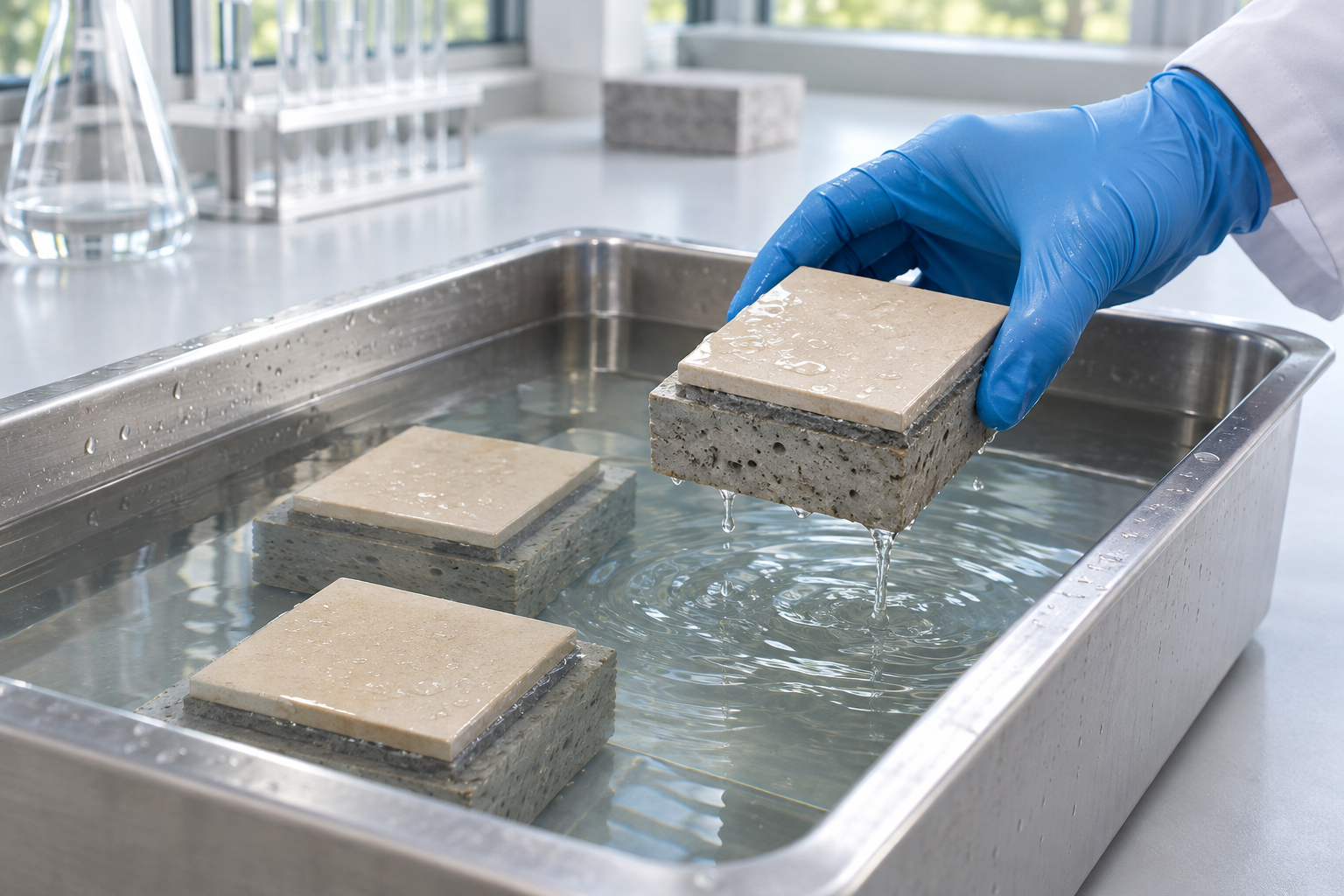
Redispersible polymer powder redistributes as polymer particles when the dry mix is combined with water. During hardening and water removal, the polymer contributes to the structure of the modified adhesive layer.
Depending on the grade and formulation, RDP can influence adhesion, cohesion and deformation behavior. These effects work alongside the properties of the cementitious binder and other ingredients.
Commercial RDP grades may differ in polymer composition, film-forming characteristics and behavior during water exposure. Equal dosage does not therefore establish equal bond strength after immersion.
Technical powder data can help identify candidates, but selection should include testing in the intended tile adhesive. A separately formed polymer film or an observation of redispersion cannot replace a finished-adhesive test.
Hydrophobicity, water absorption and bond strength after water immersion describe different properties.
| Property | Main consideration |
|---|---|
| Surface hydrophobicity | How water wets the material surface |
| Water absorption | How much water the material absorbs under defined conditions |
| Bond strength after water immersion | How the bonded assembly performs after specified water conditioning |
A water droplet on a specimen can provide an observation of surface wetting. It does not demonstrate that the tile adhesive meets a wet-adhesion requirement.
Water may enter through pores, specimen edges and contact zones even when the exposed surface wets relatively slowly.
When requesting an RDP sample, clarify whether the development target concerns reduced water absorption, adhesion after immersion or another property. These objectives should not be treated as interchangeable.
Confirm the cement type, source, condition and quantity. A cement change can affect water demand and property development.
If the cement and RDP are changed in the same trial, the resulting difference cannot be assigned to the polymer powder alone.
Particle-size distribution and the proportion of fine material influence packing, mixing-water requirements and the hardened structure.
Use consistent aggregate and filler sources when comparing RDP grades. Where possible, retain the same batches throughout the comparison.
Cellulose ether affects water retention, rheology and application behavior. Its grade and dosage can influence adhesive spreading and contact with the tile.
A contact problem caused by application behavior may remain unresolved even after increasing RDP.
Air content also deserves attention. Changes in entrained air can affect fresh density and the structure of the adhesive layer.
Where relevant, measure fresh-mortar density or air content using the adopted procedure rather than relying only on visual inspection.
Mixing water affects consistency, application and the conditions under which the adhesive develops its structure.
Too much water may alter the hardened layer, while insufficient water can make spreading and contact formation difficult. The appropriate amount must be established for the formulation and application.
Two comparison approaches can be useful.
A fixed-water trial shows what happens when one RDP grade directly replaces another without changing water content. A separate trial adjusted to similar working consistency helps assess water demand and practical application behavior.
Keep these trials distinct. If both the RDP grade and mixing water change, the performance difference cannot be attributed solely to the polymer.
Record actual water quantities, mixing duration and resting time so the preparation can be repeated.
An adhesion test evaluates a bonded assembly. Tile and substrate conditions are therefore part of the measurement.
Control surface cleanliness, material type, adhesive thickness, spreading method, the interval before tile placement and the bedding procedure.
Specimens made with different tiles or substrates should not be treated as a single-variable comparison of RDP grades.
Conditioning also needs consistent execution. Follow the selected procedure for curing, water immersion and the steps between conditioning and testing.
A specimen tested in one moisture state should not be directly compared with another specimen prepared or stored differently without acknowledging that difference.
The measured strength describes the load resisted by the assembly. The failure location provides additional information about where the assembly was limited.
| Observation | Areas to investigate |
|---|---|
| Failure between tile and adhesive | Tile contact, wetting, placement procedure and formulation compatibility |
| Failure between substrate and adhesive | Substrate preparation, condition and contact formation |
| Failure within the adhesive layer | Adhesive structure and cohesive performance |
| Failure within the tile or substrate | Limitations of the test assembly and interpretation of the result |
These observations guide investigation but do not establish a single cause by themselves.
For example, failure at the tile interface does not automatically prove insufficient RDP dosage. Adhesive transfer, placement timing and surface condition should also be checked.
Record whether the failure pattern changes after water immersion. A change in failure location can be as informative as a change in the measured value.
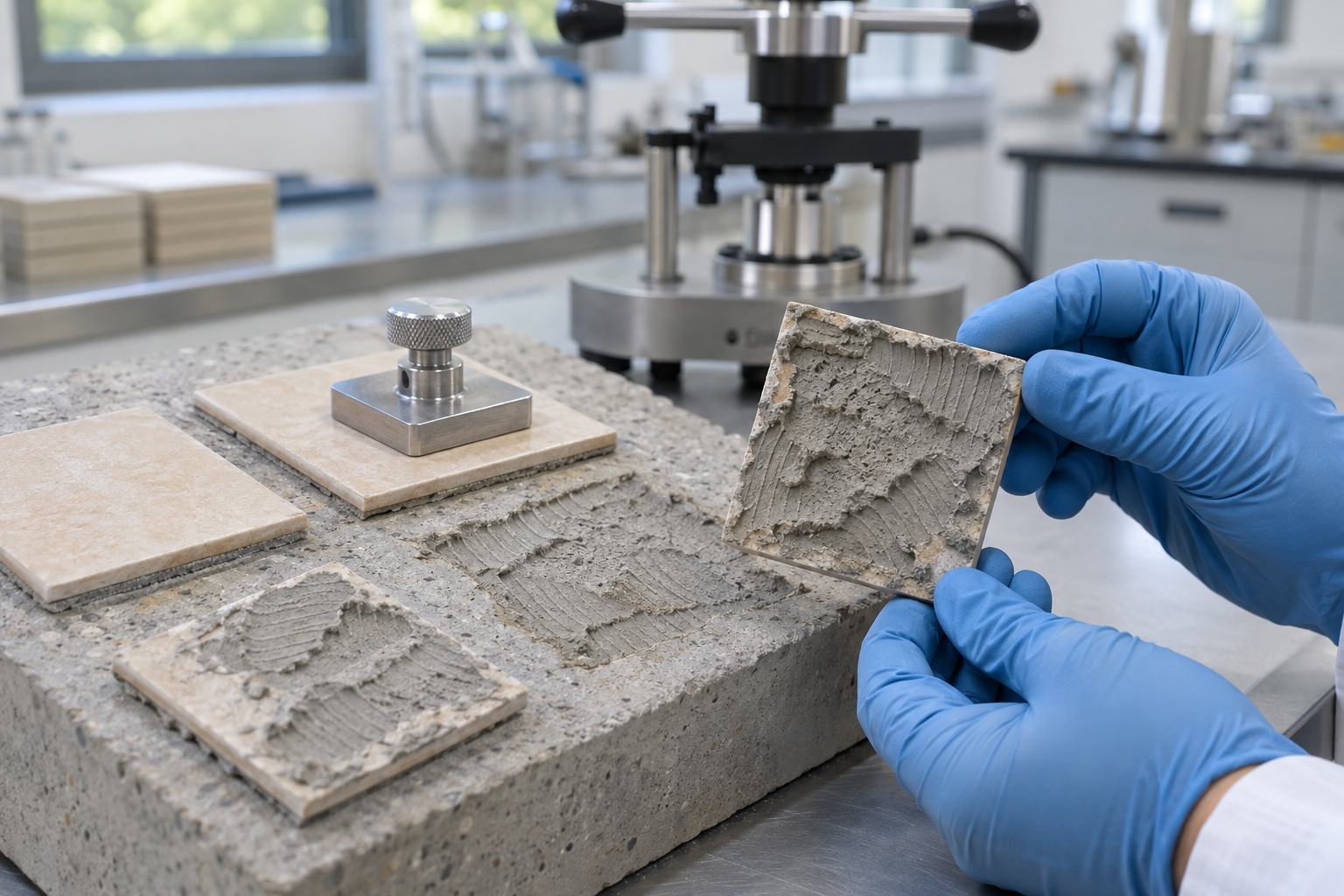
Begin with a documented reference formulation. Compare the current RDP grade and a candidate at the same dosage, using an identical calculation basis.
If dosage effects also need investigation, arrange a separate series with defined dosage levels. State how other ingredients are adjusted to maintain the intended batch total.
The comparison record should include:
| Item | Information to retain |
|---|---|
| RDP | Grade, batch number and dosage basis |
| Dry formulation | Sources and quantities of all ingredients |
| Water | Actual amount used for each mix |
| Preparation | Mixing sequence, duration and resting time |
| Specimens | Tile, substrate, layer thickness and placement procedure |
| Conditioning | Curing and water-immersion conditions |
| Testing | Specimen state, timing and test procedure |
| Results | Individual measurements and corresponding failure locations |
Use the specimen count, calculation rules and treatment of unusual results required by the adopted method.
A single specimen is insufficient to characterize the formulation or establish a repeatable difference between grades.
Additional testing after immersion followed by drying may be useful when the development objective includes understanding whether a change is reversible.
However, this is a separate conditioning route. It must not replace the required result after the specified water-immersion procedure.
Keep the following groups clearly identified:
Specimens after reference curing;
Specimens after specified water conditioning;
Specimens after water exposure followed by additional drying.
Each group needs its own documented preparation and test conditions.
Separating the groups prevents results obtained at different moisture states from being combined into one comparison.
A useful sample request describes the adhesive application, cement system, current RDP dosage, mixing-water content and target properties.
If a wet-adhesion issue has already been identified, provide the initial adhesion result, the result after immersion, the conditioning procedure and the observed failure locations.
Also explain whether cement, aggregate, cellulose ether, defoamer or another ingredient has recently changed.
The statement “adhesion is lower after water exposure” describes the symptom but gives limited direction for grade selection. A complete record helps identify which candidate powders and dosage levels are worth testing.
Selecting RDP for tile adhesive requires a connection between raw-material characteristics and finished-formulation results. Consistent water content, controlled specimen preparation and failure analysis provide a clearer basis for deciding whether to adjust the polymer grade, dosage, other ingredients or the preparation procedure.
 Why Does Tile Adhesive Bond Strength Change After Water Immersion? RDP Selection and Formulation Che
 How to Calculate RDP Dosage: Dry-Mix Percentage, Cement Basis and Kilograms per Tonne
 RDP Tg vs MFFT: Understanding Temperature Parameters for Mortar Selection
 RDP in Self-Leveling Compounds: Balancing Flow, Adhesion and Surface Performance