
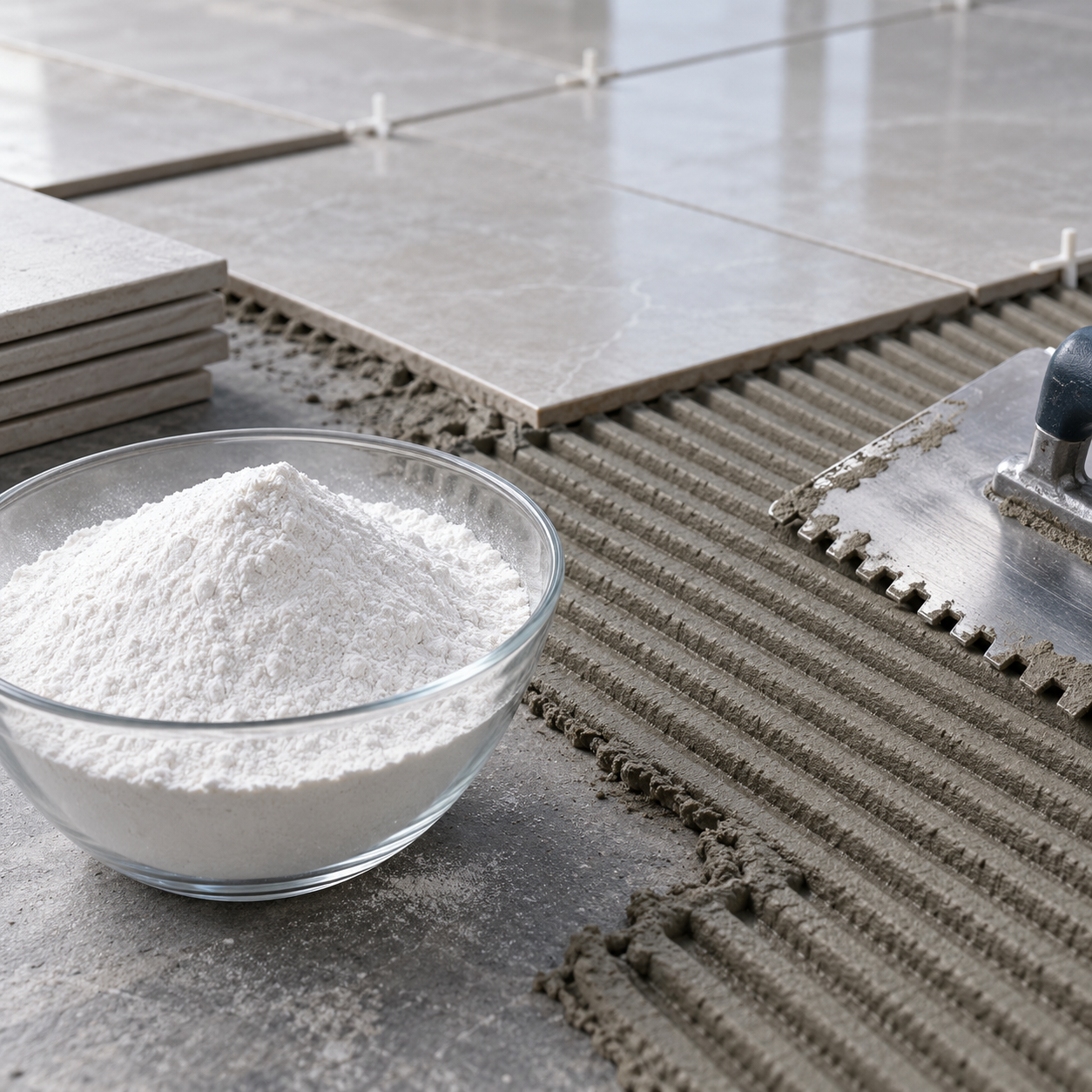
Redispersible polymer powder, commonly abbreviated as RDP, is used as a polymer modifier in cement-based tile adhesive formulations. After water is added, the powder redisperses and distributes polymer particles throughout the fresh mortar. As the mortar dries and cement hydration progresses, these particles contribute to the formation of a polymer-modified cement matrix.
RDP can support adhesion, flexibility and water resistance, but not every powder produces the same result. A general-purpose grade, a flexible grade and a water-resistant grade may differ in polymer chemistry, glass transition temperature and interaction with other formulation ingredients.
Selecting an RDP for tile adhesive should therefore begin with the required performance of the finished adhesive rather than a single raw-material value.
Traditional cement and sand mortars may be unsuitable for demanding tile installations, particularly when the system involves:
Low-absorption porcelain tiles;
Large-format tiles;
Smooth concrete substrates;
Exterior temperature changes;
Moist or intermittently wet conditions;
Deformable substrates;
Thin-bed application.
RDP can modify the hardened mortar structure and support bonding at the tile and substrate interfaces.
Its main contributions may include:
The polymer phase can support adhesion between the cementitious mortar and different substrates. The final tensile adhesion strength depends on the complete formulation, tile type, substrate preparation and curing conditions.
Cementitious materials are relatively rigid. A suitable polymer can reduce brittleness and improve the ability of the adhesive layer to accommodate limited deformation.
Certain RDP grades can help maintain adhesion after water exposure. Water resistance depends strongly on polymer chemistry, dosage, cement matrix and protective-colloid system.
RDP can influence mortar cohesion and trowelling characteristics. However, water retention and primary thickening are usually controlled more directly by cellulose ether.
RDP may contribute to the overall open-time performance of a balanced formulation, but it should not be described as the sole open-time additive. HPMC or HEMC, water demand, temperature and substrate absorption are also important.
RDP cannot independently guarantee:
No tile detachment;
No hollow areas;
A specific open time;
A particular slip value;
Compliance with a tile-adhesive standard.
Finished adhesive performance depends on:
Cement type and content;
Aggregate grading;
Filler type;
RDP grade and dosage;
Cellulose ether;
Starch ether or other rheology modifiers;
Mixing-water level;
Tile water absorption;
Substrate condition;
Application thickness;
Curing and testing conditions.
Standards such as EN 12004 apply to the finished tile adhesive, not to RDP as an isolated raw material.
Many commercial RDP products used in tile adhesives are based on vinyl acetate-ethylene copolymers, commonly described as VAE or EVA-based powders. Other chemistries and modified copolymers are also available.
Polymer chemistry influences:
Flexibility;
Film formation;
Adhesion to different substrates;
Water resistance;
Alkali stability;
Interaction with cement;
Long-term performance.
The commercial name “RDP” does not identify the exact polymer. Buyers should request the polymer basis and intended application from the supplier.
Glass transition temperature, or Tg, is one reference used to describe whether a polymer film tends to behave more flexibly or more rigidly under specified conditions.
In general:
A lower-Tg grade tends to form a softer and more flexible polymer phase;
A higher-Tg grade tends to form a harder polymer phase;
An intermediate grade may provide a balance between cohesion and flexibility.
This is only a general tendency. Tg alone does not fully predict tile-adhesive performance because polymer composition, molecular structure, protective colloid and mortar interaction also matter.
For adhesives requiring greater deformation capacity, lower-Tg or specifically flexible grades may be evaluated. For general interior applications, a balanced grade may be sufficient.
The minimum film-forming temperature, or MFFT, indicates the temperature above which a polymer dispersion can form a coherent film under the stated test conditions.
This matters because tile adhesive may be applied at relatively low ambient temperatures. If the polymer does not form an effective phase under the application and curing conditions, the expected modification may not fully develop.
MFFT should not be considered in isolation. Cement hydration, moisture availability and curing temperature also influence final performance.
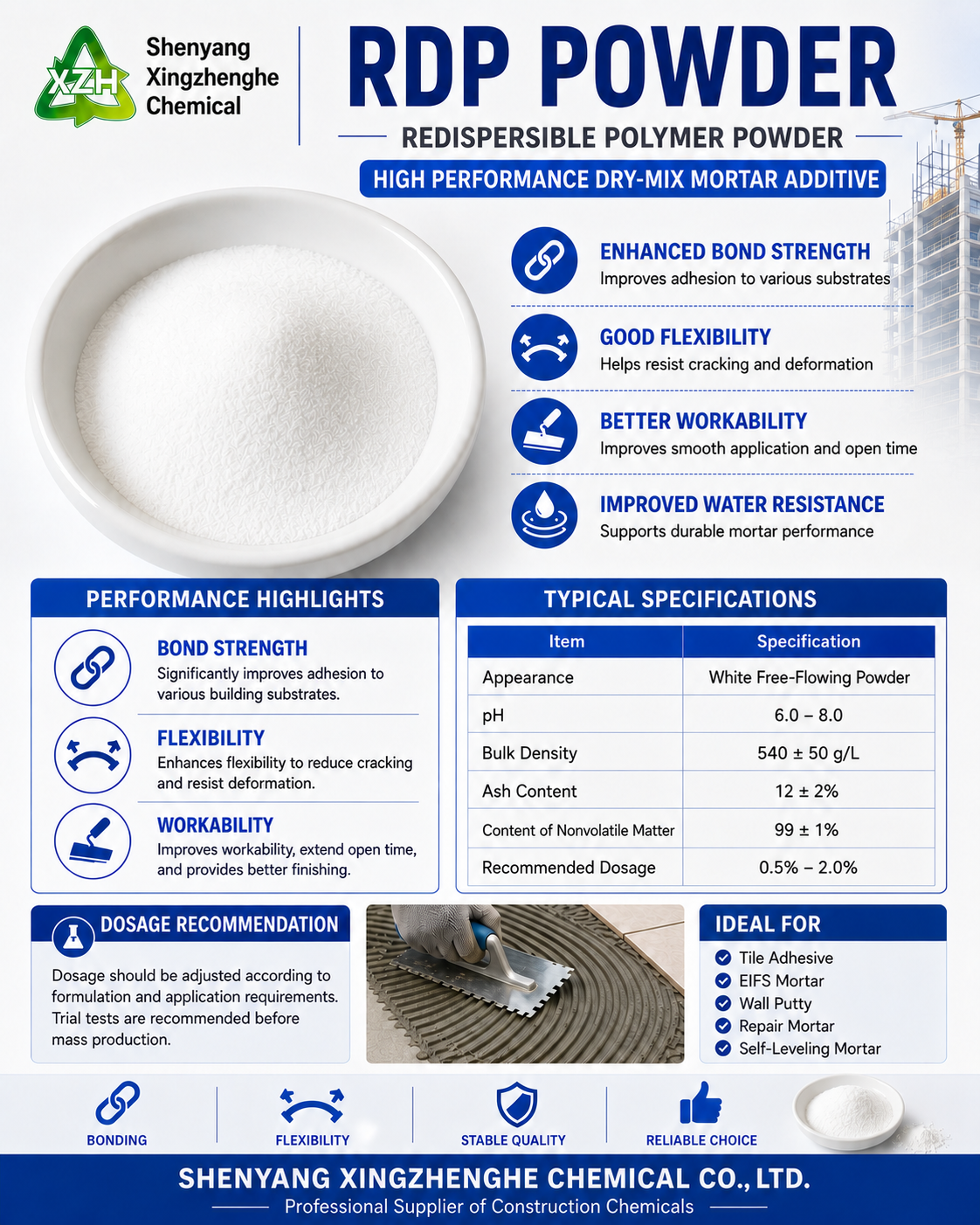
Ash content is frequently used to compare RDP grades, but it must be interpreted carefully.
The powder normally contains polymer, protective colloid and anti-caking materials. After ignition, inorganic materials remain as ash.
A very high ash result may indicate a lower effective polymer fraction, but:
Test temperature and method must be the same;
Normal anti-caking materials also contribute to ash;
The lowest ash does not automatically provide the best adhesion;
Solid content is not identical to polymer content.
Ash is useful for quality control and batch comparison, but final mortar tests are more important than a single ash value.
RDP must redisperse adequately when the dry mortar is mixed with water. Poor redispersion can result in:
Uneven polymer distribution;
Lumps;
Inconsistent workability;
Reduced modification efficiency;
Batch variation.
A simple water-dispersion observation can help identify major differences, but it cannot replace performance testing in the complete tile-adhesive formulation.
Evaluation may include:
Wetting speed;
Ease of dispersion;
Presence of lumps;
Sedimentation;
Film formation;
Stability after standing.
Tile adhesives may be exposed to moisture during use or during standard testing. An RDP grade intended for wet conditions should be evaluated for retained adhesion after the required conditioning procedures.
Water resistance is influenced by:
Polymer composition;
Protective-colloid level;
RDP dosage;
Cement hydration;
Porosity;
Water-to-binder ratio;
Curing;
Interaction with cellulose ether.
The term “waterproof RDP” should not be interpreted as meaning that RDP alone turns any mortar into a waterproof product.
RDP and cellulose ether have complementary functions.
| Additive | Principal Function in Tile Adhesive |
|---|---|
| RDP | Polymer modification, adhesion, flexibility and water-resistance contribution |
| HPMC/HEMC | Water retention, consistency, open-time support and application rheology |
| Starch ether | Additional rheology and slip-control adjustment |
| Defoamer | Air-content adjustment where required |
| Hydrophobic additive | Water-repellency adjustment in selected systems |
Changes in cellulose-ether grade may alter water demand, air content, open time and adhesion results. RDP should therefore be evaluated with the exact cellulose ether used in production.
There is no universal dosage.
The appropriate amount depends on:
Required adhesive classification;
Polymer efficiency;
Tile type;
Interior or exterior use;
Required flexibility;
Water-exposure requirements;
Cement and filler composition;
Cost target.
A preliminary laboratory programme should test several dosage levels while keeping all other raw materials constant.
The evaluation should include:
Mixing-water demand;
Wetting and trowelling;
Slip;
Open time;
Tensile adhesion under the required conditioning;
Deformation where relevant;
Air content;
Setting behaviour;
Cost per tonne of finished adhesive.
The correct dosage is the level that helps the complete formulation meet its target performance with acceptable consistency and cost.
A lower-priced RDP may require a higher dosage to reach the same finished-mortar performance. Formulation cost should be calculated based on the dosage required to pass the target test.
A high nonvolatile content does not mean that the same percentage is functional polymer. Protective colloid and anti-caking materials are also nonvolatile.
Tg provides useful information about polymer-film behaviour, but does not replace adhesion, water-resistance and deformation tests.
Excessive polymer powder can change water demand, setting, air content, strength balance and formulation cost. Performance does not necessarily increase proportionally.
A grade that works with an absorbent ceramic tile may not give the same result with porcelain tile or a smooth, low-absorption substrate.
To compare RDP samples fairly:
Use one controlled tile-adhesive formulation.
Keep cement, sand, cellulose ether and water constant.
Condition raw materials and specimens consistently.
Use coded samples for blind comparison.
Measure fresh-mortar properties.
Test adhesion after the relevant conditioning procedures.
Examine flexibility or deformation where required.
Repeat the test to evaluate consistency.
Compare performance cost rather than powder price alone.
A supplier can make a more relevant recommendation when the buyer provides:
Tile-adhesive type;
Target standard or classification;
Tile type and water absorption;
Interior or exterior use;
Dry or wet service conditions;
Required flexibility;
Existing RDP dosage;
Cement and cellulose-ether system;
Main performance problem;
Destination climate;
Required packaging and quantity.
Selecting redispersible polymer powder for tile adhesive requires a balance of adhesion, flexibility, water resistance, redispersibility and compatibility.
Polymer chemistry, Tg, MFFT, ash content and solid content provide useful raw-material information, but none of them can independently predict the performance of the finished adhesive.
The most reliable approach is to test several RDP grades and dosage levels in the actual formulation, using the intended tile, substrate, conditioning procedure and applicable product standard.
 Why Does RDP Change After Long-Term Storage? Moisture, Caking, Redispersion and Packaging Explained
 How Does Redispersible Polymer Powder (RDP) Improve the Performance of Tile Adhesive?
 How to Compare RDP Samples Before Changing Suppliers
 What Is Redispersible Polymer Powder (RDP)? How It Works in Dry Mix Mortar